
Defined Information, Better Outcomes
Public construction programs are increasingly requiring digital delivery, yet BIM is often still approached as a modeling exercise. The assumption is that more detailed or coordinated models will lead to better outcomes.
Experience shows that this is not where risk is reduced.
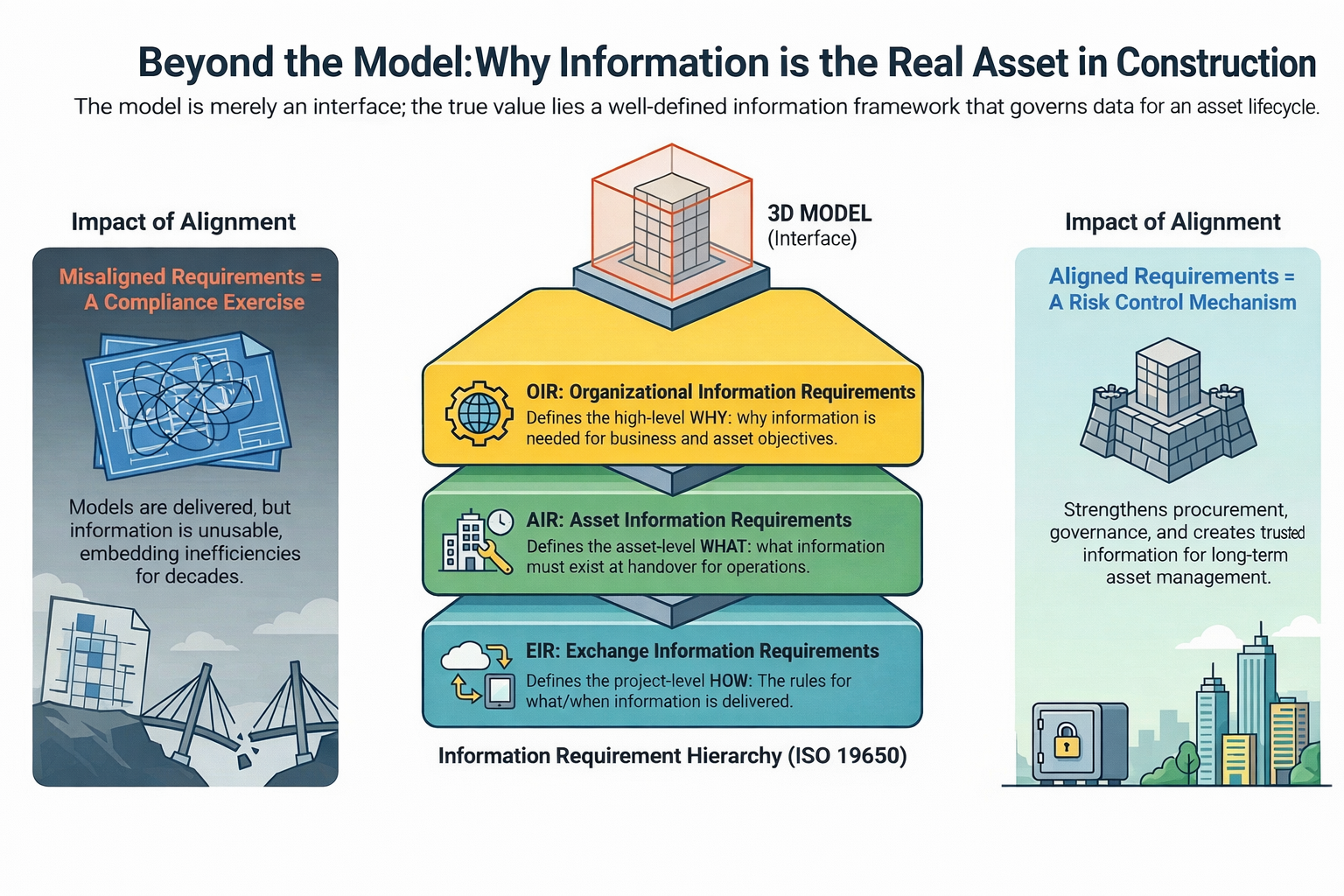
What matters is how information is defined, governed, and accepted. The model is not the deliverable; it is the interface through which information is produced and accessed.
Under ISO 19650, this starts with clarity at the organizational level. Organizational Information Requirements (OIR) define why information is needed and how it supports business and asset objectives. Where OIR is vague or absent, information production becomes disconnected from operational value.
Asset Information Requirements (AIR) translates those organizational needs into asset-level expectations. They determine what information must exist at handover to support operation and management. When the AIR is not clearly defined, handover information is often extensive but not usable.
Exchange Information Requirements (EIR) then set the rules for delivery within the project. They define what information is required, when it is needed, and how its suitability for use is assessed. When EIRs focus primarily on model format rather than information content, digital delivery becomes a compliance exercise rather than a risk control mechanism.
Projects encounter difficulty when these requirements exist in isolation or only on paper. Models may be delivered, but decision-making still relies on drawings, emails, or informal interpretation. In such cases, digital processes are present, but information governance is not.
The value of this framework becomes evident after handover. Public assets operate over long lifecycles, often under changing organizational structures. Where information is structured, current, and trusted, it supports asset management, maintenance planning, and future adaptation. Where it is not, inefficiencies are embedded for decades.
Digital delivery makes gaps visible. It reveals where responsibilities are unclear and where information is produced without a defined purpose. This visibility can be uncomfortable, but it enables accountability and transparency that traditional document-based processes cannot.
For public clients, the key question is not whether BIM is being used. It is whether OIR, AIR, and EIR are aligned and actively governing decision-making throughout delivery.
Where this alignment exists, digital delivery strengthens procurement, governance, and long-term value. Where it does not, the presence of models alone offers limited benefit.